
Case study
Keeping Guests Safe While Remaining Open for Business
15th Oct 2026


Background
Located in the heart of St Austell, Cornwall, The White Hart Hotel is a Grade II listed Georgian hotel offering guest accommodation, dining facilities and hospitality spaces. Welcoming visitors throughout the year, it is a well-established part of the local community.
When Recall South West took over maintenance of the hotel’s fire alarm system, its engineers identified several historic earth faults and open-circuit faults that were affecting system reliability. The installation had also exceeded the manufacturer’s recommended 10-year service life, making replacement the most practical long-term solution.
With the hotel remaining open throughout the project, the challenge was to deliver a modern, reliable fire detection system while minimising disruption to guests, staff and daily operations.
Challenges
Replacing a fire alarm system within an occupied hotel required careful planning and coordination. Guest bedrooms, kitchens, dining facilities and public areas all needed to remain operational throughout the works.
Access had to be scheduled around room availability and the day-to-day requirements of the hotel, while maintaining fire safety at all times. A traditional hard-wired replacement would have required extensive new cabling, increasing installation time, disruption and the amount of intrusive work within the Grade II listed building.
Recall South West therefore required a solution that could be installed efficiently, minimise disruption and provide reliable long-term fire protection.
Selecting the right system
Following an assessment of the existing installation and the operational needs of the hotel, Recall concluded that a wireless fire detection system offered the most practical long-term solution.
EMS FireCell was selected as the preferred system, providing the reliability and performance expected from a modern fire alarm installation without the extensive cabling associated with a conventional wired replacement.
By significantly reducing the requirement for new cable routes, FireCell helped limit installation time, intrusive building work and the need for subsequent making-good. This made it particularly well suited to an established hotel that needed to remain open throughout the upgrade.
Wireless survey and system design
Before the system design was finalised, EMS conducted a free underwritten wireless survey at the hotel.
This swift yet comprehensive assessment verified reliable wireless communication throughout the hotel and helped establish the optimum system design. The survey confirmed robust performance across the site, allowing Recall and the client to proceed with complete confidence.
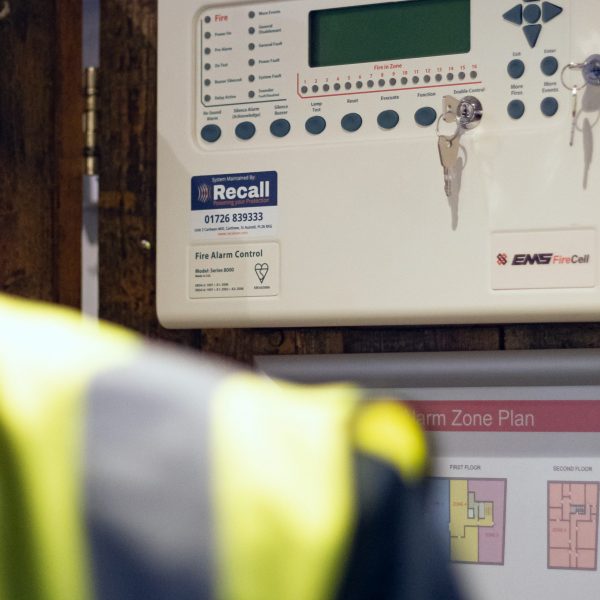
It also identified the infrastructure and equipment required for the project, resulting in a system design comprising one FireCell control panel, four Radio Cluster Communicators and 109 wireless devices.
With wireless performance validated before work commenced, Recall and the client could proceed with complete confidence in the long-term performance of the system.
Installation strategy
To complete the replacement safely and efficiently while the hotel remained open, Recall developed a carefully structured fourstage installation programme.
This approach combined advance preparation, off-site programming and coordinated engineering teams to reduce the amount of work required within occupied areas. Close communication with hotel management also allowed each stage to be scheduled around room availability and operational requirements.
1. Infrastructure preparation
Before the principal installation began, an electrician attended the hotel to install the power supplies required for the four Radio Cluster Communicators.
Completing this enabling work separately meant that the wireless infrastructure was ready before the fire alarm engineers arrived. This ensured the main installation could begin efficiently and minimised the time engineers needed to spend on site.
Separating the preparatory work from the main programme also reduced the amount of time engineers needed to spend within guest and operational areas.
2. Off-site programming
To streamline the work at the hotel, Recall programmed and configured the FireCell devices at its workshop before installation commenced.
The devices therefore arrived on site prepared for deployment, reducing the time needed for configuration and commissioning within the hotel. Engineers could focus on progressing the installation rather than undertaking programming work in busy areas.
This off-site preparation played an important part in shortening the installation programme and limiting disruption to hotel staff and guests.
3. Coordinated system replacement
During the main installation phase, Recall’s engineers worked in coordinated teams. Existing fire alarm equipment was progressively removed, with other engineers following behind to install the new FireCell devices.
This rolling replacement programme allowed the work to move systematically through the hotel while limiting the length of time individual areas were affected.
Recall worked closely with hotel management to coordinate access around room availability, guest movements and the requirements of the hotel’s kitchens and hospitality spaces. This flexible approach allowed normal activities to continue while the upgrade progressed.
The wireless nature of FireCell proved particularly valuable during this stage. With no new cabling required, engineers could avoid many of the disruptive installation methods associated with a conventional wired system.
4. Testing and commissioning
Once the installation was complete, the entire system underwent comprehensive testing and commissioning.
Every device and communication path was checked to verify correct operation and dependable system performance. Following successful testing, the completed FireCell system was handed over to the client, providing a modern fire detection solution ready to support the hotel’s ongoing fire safety requirements.
Results
The most significant achievement of the project was that The White Hart Hotel remained fully operational throughout the upgrade. Through close collaboration with hotel management, Recall coordinated work around guest occupancy and day-to-day operations. Combined with the flexibility of FireCell wireless technology, this minimised disruption and avoided the extensive building work associated with a traditional wired replacement.
The completed installation now provides reliable fire protection throughout the hotel, while simplifying ongoing maintenance and supporting the site’s future fire safety requirements.

Conclusion
The White Hart Hotel project demonstrates the benefits of wireless fire detection in complex, occupied hospitality environments. Through detailed planning, an underwritten EMS wireless survey, off-site programming and a carefully coordinated installation strategy, Recall delivered a low-disruption fire alarm upgrade without impacting day-to-day operations.
For buildings where business continuity, heritage considerations and installation efficiency are key priorities, EMS FireCell provides a proven wireless solution that helps installers deliver reliable fire protection with minimal disruption.
Want to know more about our wireless fire solutions? Contact EMS today!